Connect
Connect
Back to Bitcoin DeFi

Borrow against Bitcoin. Stay in control.

Use your BTC as collateral to borrow stablecoins and other assets. No custody, no intermediaries.

Access liquidity without selling your Bitcoin.

Borrow against Bitcoin. Stay in control. sections

RUJI Money Market

What is RUJI Money Market?

RUJI Money Market lets you do two practical things with the same system: lend assets to earn yield from borrower demand, or use your BTC as collateral when you want liquidity without selling the position you still want to hold.

Everything happens onchain, the key risk numbers stay visible while you use it, and you remain in control from deposit to repayment instead of handing the full process to an intermediary.

Comparison

Where RUJI Money Market fits best

Different lending products optimize for different collateral models and user flows. This quick view helps you see where RUJI Money Market fits best for native BTC collateral, self-custody, and clearer onchain risk checks.

Comparison table for RUJI Money Market, Aave, Morpho, Spark, and Coinbase
CategoryRUJI Money MarketAaveMorphoSparkCoinbase
CustodySelf-custody from deposit to repaymentSelf-custody on supported chainsSelf-custody in the chosen marketSelf-custody on supported Spark marketsCoinbase-led app flow into Morpho on Base
BTC collateral pathNative BTC in this Bitcoin flow, not a wrapped stand-inCollateral varies by network and supported reserveMarket-specific collateral chosen at market creationCollateral depends on the reserve design of each Spark marketBTC available through Coinbase's managed loan flow
Price feed designTHORChain enshrined oracle designed for fairer collateral pricingProtocol risk checks tied to its borrow and health-factor modelOracle is chosen market by marketSpark market pricing and risk checks set by the protocol's reserve designUnderlying Morpho market pricing, surfaced in Coinbase's app
Liquidation flowPartial liquidations routed into RUJI Trade with public price discoveryPermissionless liquidations once health factor falls too farPermissionless liquidations when LTV rises above the market LLTVPermissionless liquidations when a position moves beyond its thresholdsUnderlying Morpho liquidation logic, accessed through Coinbase
TransparencyOpen-source contracts, public audits, visible LTV, and liquidation priceVisible LTV, health factor, and liquidation thresholdsVisible LLTV, oracle, and interest model per marketVisible reserve data, liquidation thresholds, and borrow ratesLoan health shown in app, but setup stays Coinbase-led
Best forBTC holders who want native collateral, self-custody, and clearer onchain risk checksUsers who want broad DeFi lending coverageUsers who want market-level controlUsers who want a simpler blue-chip DeFi lending venueUsers who prefer a familiar app-first path

Directional snapshot based on official product docs reviewed March 29, 2026.

How it works

How it works

Start with BTC, choose whether you want yield or liquidity, and keep an eye on the risk numbers that matter.

BTC Lending

Earn with your BTC

Lend out your BTC and earn interest from borrowers and trading strategies using it. You stay in control and can withdraw anytime, as long as liquidity is available.

  • Earn passively from real borrowing demand
  • Stay in control of your assets at all times
  • Withdraw anytime when liquidity is available
BTCLending

Strategy TVL

$20.144,47

0,2764

APR

0,73%

Variable borrow APR

Deposit Asset

BTC

Available

0,000578 BTC

My Balance

$0,11

0,000001 shares

0,0516

Borrowing

Unlock liquidity without selling your BTC

Use your BTC as collateral to borrow other assets while keeping your exposure. Choose how much you borrow based on the risk you are comfortable with.

A lower LTV gives you more safety. A higher LTV gives you more liquidity, but increases your risk of liquidation.

Deposit

Borrow

Available

0,000578
BTC
$42,14
$23,88
BTC Price
$72.903,07
0%100%
Collateral Ratio
0,70
USDC Price
$1,00
Adjusted Collateral Value
$29,50
USDC Available
5.152,23$5.152,23
Annual Interest Rate
3,07%
Adjusted LTV
High: 80,96%
Liquidation Price
$59.022,33-19,04%

My Positions

DepositedBorrowedInterest RateAdjusted LTVLiquidation PriceManage
0,0001 BTC$7,29
2,02 USDT$2,02
2,64%Low: 39,65%
$28.892,94-60,37%
0,0002 BTC$13,34
7,7 USDC$7,70
3,07%High: 82,44%
$60.096,74-17,57%

Manage position

Manage your position

Once a loan is open, you can repay part of it, increase it, or swap collateral as your plan changes.

Good risk management usually comes from making small adjustments early instead of waiting for a volatile move.

Manage Position

Deposited

0,000100 BTC$7,29

Borrowed

2,02 USDT$2,02

Interest Rate

2,64%

LTV

Low: 39,63%

BTC Price

$72.901,92

Liquidation Price

$28.892,94-60,37%
Repay Loan

Available

4,52 USDT
USDT
0
0%100%
Withdraw Collateral
BTC
0
0%100%
New LTV
New Liquidation Price
Low: 39,63%
$28.892,94-60,37%

Risk & Protection

Protect your position before liquidation hits

If your loan becomes too risky, part of your BTC may be sold to repay it. That protects lenders, but it also means you lose control of your position.

By tracking your LTV and liquidation price, you can act early and stay in control.

Want to learn more about how liquidations work on Rujira?

Learn About Fair Liquidations

Liquidation levels

Safe (34% LTV)

Once your LTV hits 100%, a partial liquidation will happen. How much is sold depends on the liquidating bot. The BTC is sold as a market order on RUJI Trade to repay the debt, bringing the position back to at most 90% LTV.

Money Market explained

Money Market explained

A money market connects lenders who want yield with borrowers who want liquidity.

Liquidity pool

Instead of a bank, a smart contract

Lenders supply capital into an onchain pool. Borrowers take loans from that pool and pay interest back into it.

Risk buffer

Instead of unsecured credit, overcollateralization

You borrow against collateral that is worth more than the loan. That extra buffer is what helps protect the lender side of the market.

CDP basics

What a CDP means

A CDP, or collateralized debt position, is the core borrow loop: lock collateral, borrow against it, and keep the ratio healthy over time.

Step 01

Deposit BTC as collateral

Your BTC becomes the asset backing the position, which determines how much liquidity you can safely draw from the market.

Step 02

Borrow the asset you need

You mint borrowing power from the collateral instead of selling the BTC, which lets you access liquidity while keeping the exposure.

Step 03

Monitor the ratio before liquidation

As price moves, you can repay debt or add more collateral so the position stays comfortably away from the liquidation threshold.

Enshrined Oracles

Prices matter when loans are on the line

Borrowing only works if collateral is priced accurately. Bad prices can trigger unfair liquidations or hide real risk.

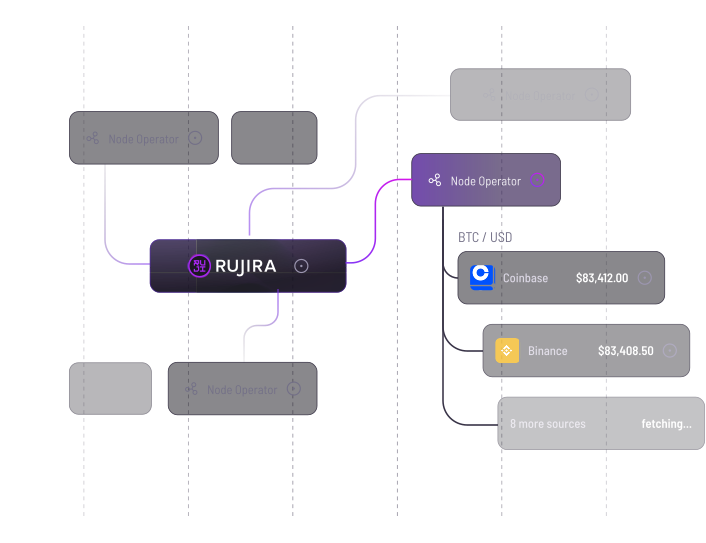
Illustration of Rujira Enshrined Oracles combining multiple market sources into one finalized price

Rujira's Enshrined Oracles are designed to make price feeds harder to manipulate. Prices are gathered from many sources, obvious outliers are removed, and the network finalizes one price before it is used by the system.

That matters most in RUJI Money Market, where loan health, liquidation price, and lender protection all depend on the market seeing a fair price.

Want the full oracle design and why it matters for fairer liquidations?

Explore Enshrined Oracles

You are ready

You now understand how borrowing on Rujira works.

Now choose how you want to use it.

Open your first loan when you want liquidity without selling BTC, or explore liquidations if you want to bid on discounted collateral.

Start with borrowing

Open your first loan

Use BTC as collateral, set a cautious LTV, and open a position you can manage comfortably.

Explore liquidations

Bid on discounted liquidated assets

Watch for discounted collateral opportunities if you want to participate on the other side of the market.

FAQ

Questions borrowers ask first

Straight answers for Bitcoin users who want to understand RUJI Money Market without getting buried in lending jargon.