How THORChain Limit Orders work (patient swaps)
THORChain is an AMM, an Automated Market Maker. That means there is no order book. Prices come from liquidity pools.
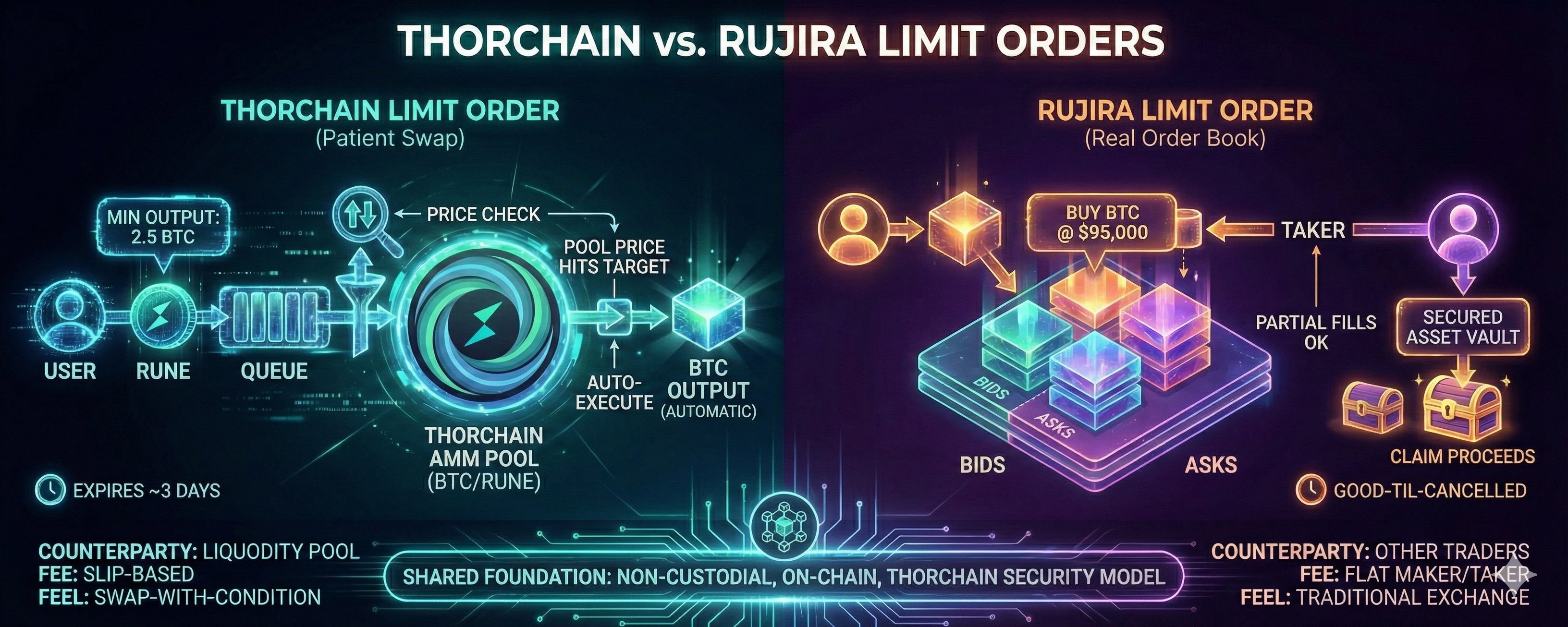
A THORChain Limit Order works like this:
You submit a swap with a condition: minimum output.
Example idea: “Swap my RUNE to BTC, but only if I get at least 2.5 BTC.”
Your funds sit in a queue onchain.
Every block, about every 6 seconds, the protocol checks the pool price.
If the pool can satisfy your minimum output, the swap executes automatically.
If not, it keeps waiting.
Key behaviors people notice
Expires after up to about 3 days, then you get refunded if the price never hits.
Your counterparty is the pool, not another trader.
You can cancel by sending a cancel transaction.
Settlement is still swap-style, so pricing is slip-based. Larger swaps relative to pool depth cost more.
Works with THORChain-native asset types, not a raw L1 BTC transaction directly from a Bitcoin wallet in the same way.
How Rujira Limit Orders work (real order book)
Rujira is an onchain order book built on THORChain’s App Layer. It behaves much more like a traditional exchange.
You place a Limit Order at an exact price.
Example idea: “Buy BTC at $95,000.”
Your order becomes a visible entry on the book.
Your order fills when another trader, or a market maker bot, takes the other side.
Key behaviors people notice
Orders are Good-Til-Cancelled. No automatic expiry.
Partial fills are normal. Your order can fill bit by bit.
When it fills, you typically need to claim or withdraw the proceeds.
Trades use Secured Assets, tokenized representations backed 1:1 by real assets held in vaults.
Supports Oracle Orders. Your price can track an oracle feed, for example “buy 2% below market.”
Fees are flat: 0.075% maker, 0.15% taker.
The practical differences that matter
1) Who you are trading against
THORChain: You trade against pooled liquidity.
Rujira: You trade against other traders, including AMM strategies created by the Rujira team, such as CCL.
2) “Your price” means different things
THORChain: You set a minimum output, a floor. You might get better, but never worse than your minimum.
Rujira: You set an exact price level on the order book.
3) Fees scale differently
THORChain: Cost grows with trade size relative to pool depth.
Rujira: Flat percentage fee, often attractive for larger trades.
4) How long your order can sit
THORChain: Up to about 3 days, then refund.
Rujira: Indefinitely, until you cancel.
5) Order-book feel vs swap feel
THORChain: Set it and forget it. If it fills, it auto-settles.
Rujira: More exchange-like. You may need to claim filled orders.
What they share
Even though they feel different:
Both are non-custodial.
Both are fully onchain.
Both rely on THORChain’s security model and vault infrastructure.
Both let you set a price and walk away.
Both allow cancellation.
One more twist: shared liquidity
Rujira can virtualize base-layer AMM liquidity onto its order book. In simple terms:
Even if you are using an order book interface, you can still benefit from the large liquidity sitting in THORChain pools, not only from other traders’ orders.
That is why they are complementary rather than competing systems.
When to use which
Use THORChain Limit Orders if you want:
A swap with a minimum output condition
A shorter time window
Automatic settlement if price is reached
Use Rujira Limit Orders if you want:
A real order book and exact price levels
Orders that can sit for weeks or months
Partial fills and maker/taker pricing
Oracle-based dynamic pricing
Tiny glossary
AMM (Automated Market Maker)
A liquidity pool that sets prices using a formula, rather than matching buyers and sellers directly.
Order book
A list of buy orders (bids) and sell orders (asks) at specific price levels.
Slippage / slip-based pricing
The larger your trade relative to available liquidity, the worse the effective price becomes.
Maker / Taker
Maker adds liquidity by placing an order. Taker removes liquidity by filling an existing order.
Oracle
A price feed used by smart contracts, such as a live market price.